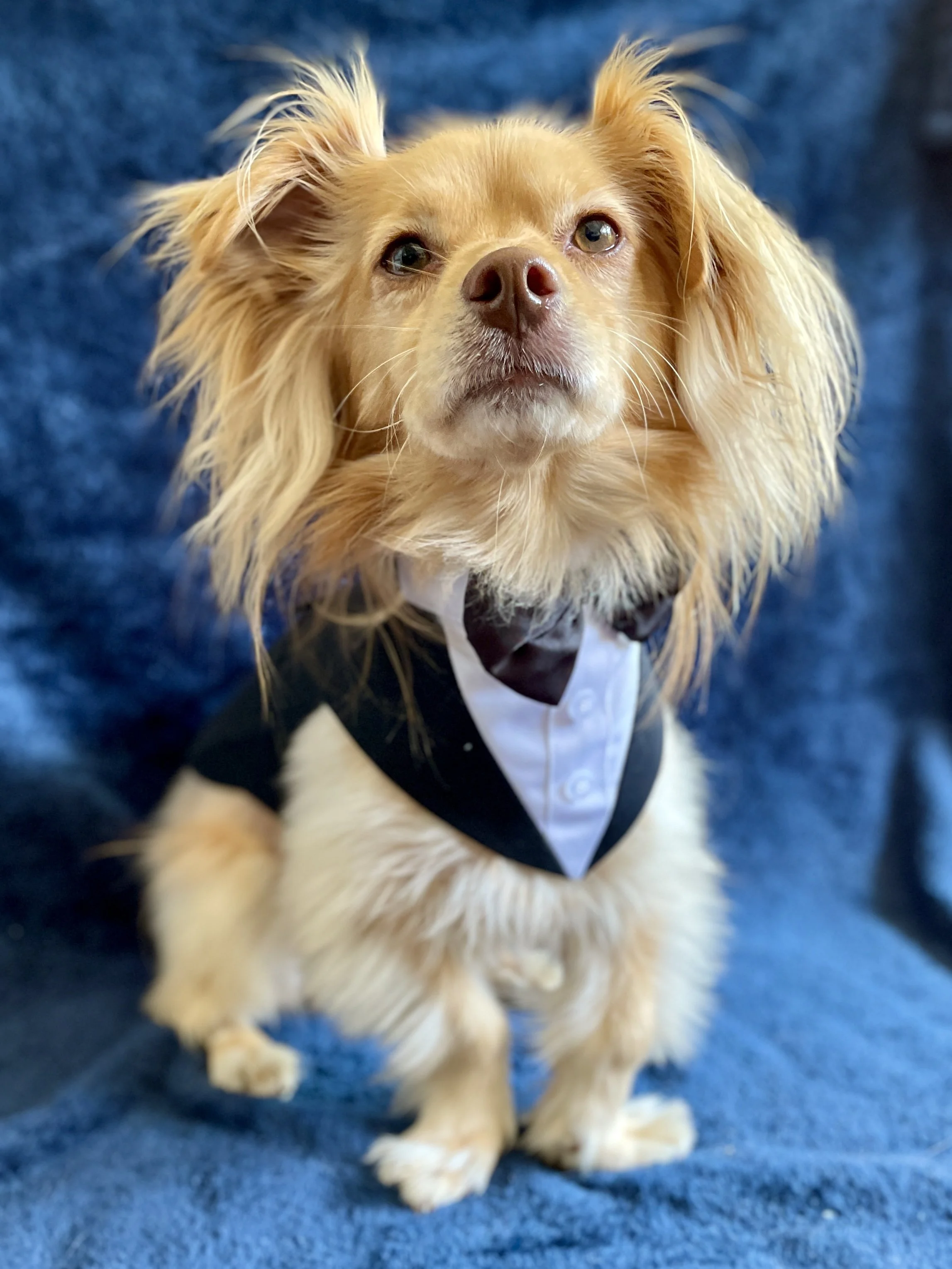
Albert Adaska
Dog
Albert B. Adaska, D.M.A. (Dog-tor of Musical Arts, summa canine laude) is thrilled to join Resonant, adding to an already distinguished and widely celebrated career in the choral world.
A graduate of the esteemed Conserva-paw-ry of Vocal Excellence and Com-pup-sition, Albert earned his Dog-torate with highest honors, completing a groundbreaking dissertation entitled On the Ontological Significance of the Sustained Whine in Post-Romantic Vocal Literature: A Treatise in 3 Movements and 1 Squeaky Toy. His work has since been referenced in academic circles, rehearsal rooms, and any space where someone has accidentally mentioned cheese.
Albert’s musical lineage is traced through the legendary pedagogue Paw-varotti, under whom he refined his signature approach to breath control, expressive phrasing, and the disciplined art of puppy dog eyes. From this training, he developed the now-renowned bel canto del barko, a refined interpretive style characterized by luminous legato, expressive restraint, and an extraordinary ability to communicate profound meaning through stillness, eye contact, and impeccable timing.
In addition to Resonant, Albert has built an extensive and highly respected reputation in the choral world, where he has been a regular collaborator with the Cappella Musica of Saint Andrew Catholic Church, the St. Philip Traditional Choir, and the acclaimed early music ensemble Jouyssance. He has also performed locally at the Pup-cific Opera Paw-ject, supporting their artist recital series. Within these ensembles, he is known for his exceptional blend, attention to detail, and advanced sol-fetch technique.
In addition to Albert’s many choral endeavors, he has also performed with contemporary artists such as Dog-ja Cat, Taylor Sniff, Snoop Dog, and Katy Paw-ry, providing stunning back-pup vocals, imaginative choreography, and incredible emotional depth. His canine colleagues include household names like Lassie, Marley, Beethoven, Pongo & Perdita, Balto, Laika, and Toto.
He also serves on the Board of Directors of Golden Hour Chamber Music, where he contributes a uniquely holistic perspective on ensemble artistry, programming vision, and the importance of maintaining both structural integrity and adequate rehearsal snacks. His colleagues describe his leadership style as “deeply intuitive,” “exceptionally adorable,” and “somehow persuasive even when silent.”
Albert’s experience with opera adds even more to his already formidable artistic trajectory. Long celebrated for his choral interpretations of sacred and early music repertoire, he now brings his signature interpretive depth to the operatic canon of Giacomo Pooch-ini, Richard Wag-ner, Woof-gang Amadeus Mutt-zart, and Bela Bark-tok, offering audiences a rare opportunity to witness a fully matured choral artist entering the dramatic operatic stage.
Critics and collaborators alike anticipate a performance of unusual emotional intelligence, technical ruff-inement, and expressive range, spanning from near-silent introspection to moments of exuberant furioso allegro di zoomies, often with minimal warning and maximum sincerity.
Despite his expanding international profile, Albert remains steadfast in his artistic principles: ensemble integrity, expressive honesty, and the belief that every rehearsal, choral or operatic, is significantly improved by snuggles, head scratches, and the possibility of cheese.